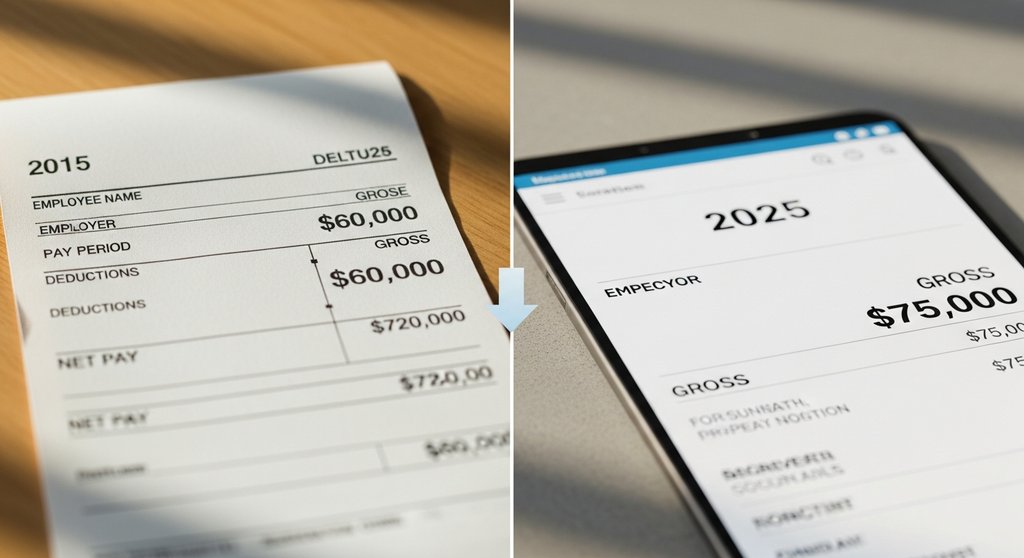
Why Your 2015 Salary Feels Smaller in 2025
Getting a raise every few years sounds like progress, but inflation can quietly erase every dollar of it without you noticing.
The raise that was actually a pay cut
Say you earned $60,000 in 2015 and you're earning $75,000 today. That's a $15,000 increase, which sounds solid. But cumulative inflation from 2015 to 2025 has run close to 36 percent, meaning you need roughly $81,600 just to stand still in real purchasing power. Your $75,000 salary is actually worth less in real terms than what you made a decade ago.
This isn't a rare edge case. Millions of workers received modest annual raises of 2 to 3 percent while inflation ran at 7 to 9 percent during 2021 and 2022. Those two years alone wiped out years of wage gains for people who never saw a single pay cut on their stub.
What the CPI number actually measures
The Consumer Price Index tracks a basket of goods: housing, food, energy, medical care, and dozens of other categories. It's an average, which means your personal inflation rate can differ significantly. If you own your home and drive infrequently, your real rate over the past decade was probably lower than the headline figure. If you rent and commute daily, it was likely higher. Try the inflation adjusted value calculator to see your own numbers.
Still, the CPI is the standard benchmark for adjusting historical dollar amounts, and it's what most financial calculations use. When you hear that a 1990 dollar is worth about 42 cents today, that figure comes directly from CPI data. The practical use of this isn't just trivia; it's how you evaluate whether a pension, a long-term contract, or a salary offer actually makes sense.
Three scenarios where this math changes real decisions
First, negotiating a job offer. If a company offers you $95,000 and your last job paid $88,000 three years ago, a quick inflation adjustment shows that $88,000 from 2022 is equivalent to about $100,000 today. The new offer is actually a step down, not a step up. Knowing that number before you respond changes the conversation entirely.
Second, evaluating a rental property. If you bought a building in 2010 for $400,000 and someone offers you $650,000 today, that sounds like a $250,000 gain. Adjust for inflation and that $400,000 in 2010 dollars is worth roughly $575,000 now, so your real gain is closer to $75,000 before taxes and costs. Still a gain, but a very different one.
Third, planning retirement withdrawals. A $1,500 monthly pension that started in 2005 has the purchasing power of about $990 today after cumulative inflation. Retirees who didn't account for this gap are often surprised to find their fixed income covers noticeably less each year.
How to run the numbers in under a minute
You don't need a spreadsheet or an economics degree. An inflation adjusted value calculator lets you enter any dollar amount, pick a start year, and see its equivalent value in any later year. Most tools use Bureau of Labor Statistics CPI data updated annually, so the output reflects the actual recorded inflation, not an estimate.
The exercise is worth doing any time money from the past gets compared to money today. That includes salary history, home prices, investment returns, tuition costs, and even inheritance values. Once you start seeing dollar amounts in real terms rather than nominal ones, a lot of financial decisions that looked straightforward start to look very different.